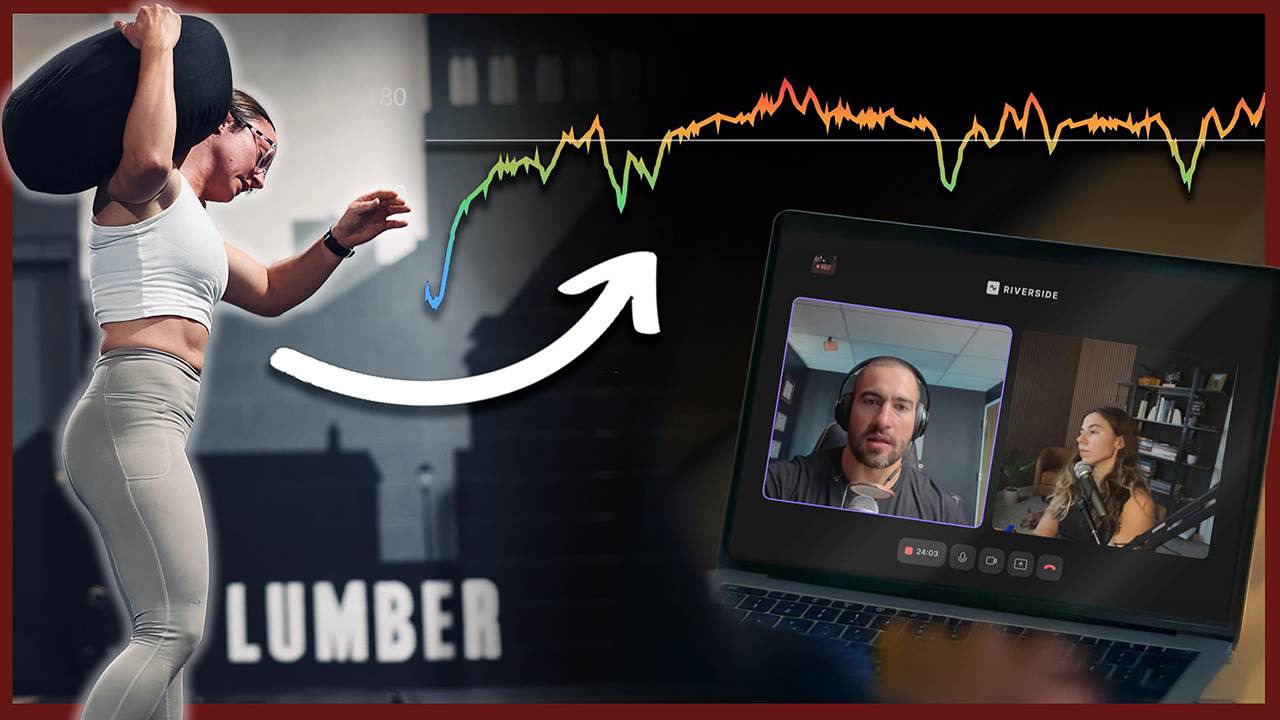
This is an episode of Programming TV where I walk through a full week of training I wrote for a client in her 60s. I’ll call her “Grace” (not her real name). She’s a longtime CrossFit athlete who has stepped away from CrossFit, wants to keep her strength post-menopause, wants to run better 5Ks and 10Ks, might do a HYROX down the road and wants to keep (or improve) her ability to do strict pull-ups in higher volumes.
The short version: I put the hardest lifting as far from her key runs as possible. Two lifts open the week, a tempo run sits on Wednesday, an upper-body lift is sandwiched between two run days, an interval run closes the work week and a catch-all lower-body and pull-up lift lands on Saturday. The runs stay moderate, and the lifts lean on simple exercises and hypertrophy work because this was only week two of working together.
What is a hybrid athlete?
“Hybrid athlete” is a buzzword right now, but it fits here: Grace lifts, she runs and she has other responsibilities to balance. Honestly, I don’t love the term. To me the essence is that you’re committed to more than one goal, like wanting to run and also do pull-ups, or run and also squat well. Most people aren’t professional athletes dedicating all their time to one thing, so the real work is juggling priorities that can pull against each other. Grace also has years of training behind her and a higher biological age, which affects how fast we can ramp things up.
How do you program lifting and running in the same week?
- Keep the most intensive lifting away from the important runs. For more on this, read my strength and VO2 max programming battle and the episode on powerlifting and endurance trail running.
- Give the priority goal the best slot. If lifting mattered most, priority lifting would come right after easy days, with a break before any run. As a race gets closer and run volume ramps up, the run takes the slot where she has the most resources.
- Keep squatting away from runs. Most runners find the squat pattern beats up the joints more, so Monday’s squat day sits roughly 48 hours before the Wednesday run. That helps longevity and performance.
What does Grace’s week look like?
| Day | Session | Focus |
|---|---|---|
| Monday | Lift | Squatting, pulling and a little extra conditioning |
| Tuesday | Lift | Hinging, pressing and core |
| Wednesday | Run | Tempo run |
| Thursday | Lift | Upper-body pressing and pulling in supersets |
| Friday | Run | Interval run |
| Saturday | Lift | Lower body, strict pull-ups and core |
| Sunday | Recovery | Long walk of her choosing, out of the gym |
What do the lifting days look like?
- Monday (squat, pull, conditioning): 5 minutes of cardio, a hip flow sequence, then 3 rounds of single-leg adductor rocks and 5 bodyweight squats. Main work is kettlebell goblet squats (3 × 10–12 with a 2-second lower), step-back lunges holding dumbbells, machine-assisted pull-ups (4 × 10–12) and a banded or machine lat row (3 × 12–16). She finishes with 15 minutes on the rower at a smooth pace and some box breathing.
- Tuesday (hinge, press, core): alternating lizards, hip lifts and good mornings to prep, then RDLs from the rack (a top-down hinge keeps positions better than ripping a deadlift off the floor) and a machine hamstring curl. I like dedicated hamstring work for any runner. Next come two sets of a seated high-incline dumbbell press and an incline dumbbell bench where she lowers the incline each set with the same weight, then Russian twists, plank shoulder taps and an easy Echo Bike.
- Thursday (upper body between two runs): 5 minutes on the stair stepper, then 3 rounds of a 6-breath hollow hold, 6 alternating lizards and 6 Blackburns. The main work is a machine chest press supersetted with a lat pulldown, then push-ups and ring rows, then machine triceps extensions and dumbbell hammer curls. It’s a horizontal press, vertical pull, horizontal press, horizontal pull pattern, with an extra vertical pull because she wants more pull-up strength.
- Saturday (lower body, pull-ups, core): a warm-up of an empty barbell, a 20-second squat hold, dead bugs and glute bridges, then 4 sets of 8–10 on the leg sled. She adds load from last week, because people often undershoot on new equipment. Deadlifts follow in a 12-10-8-6 pattern with full rest and climbing weight, then the pull-up work (see below) and a core finisher.
The leg sled is a great option for runners who want a hypertrophy stimulus on the legs without much forward knee travel or shear on the back. If your knees complain, read how to build squat strength without knee pain.
How did I program the two runs?
Wednesday is the tempo run. After an easy running warm-up and dynamic drills, she does 3 sets of 12 minutes with a heart rate that climbs progressively from zone 2 to zone 3, walking 2 minutes between. That’s about 45 minutes total and 36 minutes of running. She had mostly been running 5K-type distances at a moderate effort, so this is an introduction to the style of training I like to write. She finishes with a seal stretch, hip flexor stretch and couch stretch. To set your own zones, use the heart rate zone calculator and read 6 principles of zone 2 training.
Friday is the interval run. I left the warm-up open-ended on purpose: with a new client there’s already so much information coming at them that “do the warm-up you normally do” is one less thing to dig up. The session is 5 rounds of 1 minute easy running with nasal breathing only, 2 minutes at her estimated 5K time-trial pace and a 2-minute brisk walk. Two minutes at 5K pace isn’t a big ask with walking mixed in, so the session stays moderate. She cools down with a 5–10 minute walk and 2–3 rounds of a frog stretch and a supine hamstring stretch. For more on how I think about pacing, see zones vs. pace and RPE vs. percentages.
How do you build strict pull-up strength for an older athlete?
- Use a machine-assisted pull-up. The strength curve is the same from bottom to top, unlike a band, and her gym has one.
- Train the lats for size. Anyone with a low or a high training age can benefit from hypertrophy work, and I haven’t found a downside to building the lats. See the role of hypertrophy in CrossFit performance and hypertrophy for CrossFit.
- Touch vertical pulling three times a week. Monday has the assisted pull-ups, Thursday has the pulldown and Saturday has the strict work.
- Prep before the hard singles. Even when you’re warm, a high-effort pull-up needs ring or TRX rows and scapular pull-ups first.
- Use cluster sets. Saturday has 5 sets of 1.1.1: one rep, rest as needed, another rep, rest as needed, a final rep, then 2 minutes of rest. That’s about 15 pull-ups, a lot of work for someone who can occasionally do doubles but struggles to string reps together.
The Saturday finisher is a rotating format at one station every 45 seconds for 18 sets: burpees, Echo Bike at a cruise pace, inchworm planks, rowing at a cruise pace, hanging knee raises and a sled push on the lightest setting. The note on it says to keep the effort moderate and repeatable across all three rounds.
What can you take from this week?
- Keep the first weeks simple. Grace was in week two, so I kept the complexity low while she got used to new exercises.
- Build a base before you add intensity. Both runs are moderate on purpose.
- Let the priority goal pick the slots. Lifting-first and running-first athletes should have different weeks. For help finding the right volume, read volume or intensity?
- Plan strength around endurance work on purpose. For more on lifting alongside endurance training, listen to strength and conditioning for triathlon and strength training for triathlon with Day Muñoz.
If you struggle with conflicting goals, I’m happy to do an episode like this or walk through your situation on a coaching consult. Want more programming breakdowns? Watch the triathlete strength programming battle and the masters CrossFit competition prep battle.